Swiss Travel Pass vs Half Fare Card: Which Saves You More in 2026?
Choosing between the Swiss Travel Pass and the Swiss Half Fare Card is the single biggest money decision of your Switzerland trip - the difference can easily be CHF 200 per person. The short answer : the Swiss Travel Pass wins for fast-paced trips of 3-8 days with daily train travel, while the Half Fare Card wins for longer, slower trips or stays based in one region. Here is how to know which side you are on.
The two passes at a glance
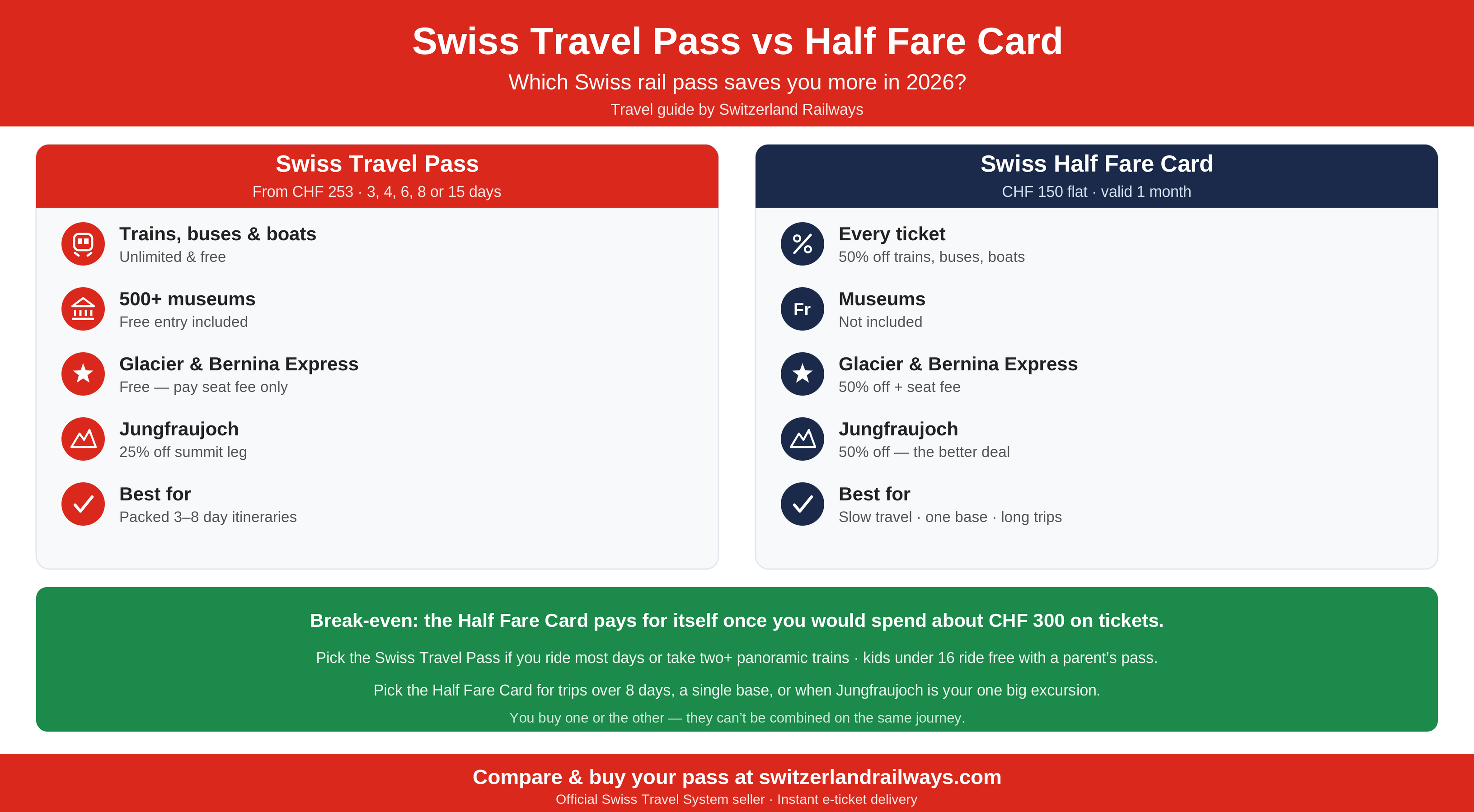
Before diving into the math, it helps to see the two passes side by side. The Swiss Travel Pass is an all-inclusive ticket priced from CHF 253 for three days in second class, valid for 3, 4, 6, 8 or 15 consecutive days, and it gives you unlimited free travel on trains, buses and boats, free entry to more than 500 museums, and free travel on the Glacier Express and Bernina Express (you pay only the seat reservation). It offers 25% off Jungfraujoch and 50% off most other mountain excursions.
The Swiss Half Fare Card, by contrast, is a flat CHF 150 and valid for a whole month. It does not include anything for free; instead, it halves the price of virtually every ticket - trains, buses, boats and most mountain railways, including 50% off Jungfraujoch. Museums are not included. In short, the Swiss Travel Pass is built for packed itineraries, while the Half Fare Card suits slow travel, a single base and longer stays.
There is also the Swiss Travel Pass Flex - the same coverage as the regular pass, but usable on non-consecutive days within a month. Choose it if your itinerary has rest days.
The break-even math
The Half Fare Card costs CHF 150 and halves your fares, so it pays for itself once you would otherwise spend about CHF 300 on regular tickets - roughly CHF 240-300 depending on what you ride. Nearly every visitor who spends a week in Switzerland crosses that line.
The real question is whether the Swiss Travel Pass beats it. A 4-day Swiss Travel Pass costs around CHF 300 in second class - about CHF 75 per day. On days when you are doing a big intercity hop plus local transport (say Zurich to Interlaken plus a boat trip), you will use CHF 80-120 of travel and the pass wins comfortably. On a day when you wander one town, you might use CHF 15, and the pass loses badly. The pass rewards movement; the more you ride, the better its value.
Three real trip examples
Trip A - 4 days, fast pace (Zurich → Lucerne → Interlaken → Jungfraujoch → Zurich).
Full-fare cost of trains, boats and the Jungfraujoch excursion is roughly CHF 480. With the Half Fare Card: CHF 150 + ~CHF 240 = CHF 390. With a 4-day Swiss Travel Pass: ~CHF 300 + Jungfraujoch at 25% off (~CHF 158) = ~CHF 458, but the pass also covered every bus, boat and museum. On this itinerary, they are close - the deciding factor is Jungfraujoch, where the Half Fare Card's 50% beats the pass's 25%.
Trip B - 8 days, daily movement including the Glacier Express.
The Glacier Express alone is CHF 159 full fare (plus reservation). Add Zermatt, St. Moritz, Lucerne and Interlaken legs, and you would spend CHF 700+ on tickets. The 8-day Swiss Travel Pass covers all of it (you pay only for seat reservations) - the pass wins by CHF 150-250.
Trip C - 12 days based in Interlaken, hiking most days.
You travel “properly” only 4-5 days. A 15-day pass is overkill; the Flex is decent, but the Half Fare Card wins - CHF 150, valid the whole month, 50% off every lift and mountain railway, including 50% off Jungfraujoch.
Which pass wins, at a glance
If you would rather skip the arithmetic, the summary below distils the coverage, the break-even point and the rules of thumb into a single view so you can decide in seconds.
Rules of thumb
Choose the Swiss Travel Pass if you will ride trains on most days, your route includes two or more panoramic trains, you love museums, or you are travelling with children under 16 (they ride free with the Swiss Family Card when a parent holds a pass). Choose the Half Fare Card if your trip is longer than 8 days, you are based in one region, Jungfraujoch is your big-ticket item, or you simply hate schedule pressure. Whichever you pick, buy before you fly - both passes are delivered digitally when you book online with Switzerland Railways, an official authorised seller of Swiss Travel System products, so your ticket is on your phone the moment you land.
Frequently Asked Questions
Can I combine the Swiss Travel Pass and Half Fare Card?
No. You need to choose one or the other, as they cannot be combined or stacked for the same journey.
Does the Half Fare Card cover the Glacier Express?
Yes. The Swiss Half Fare Card gives you 50% off the standard Glacier Express fare. Swiss Travel Pass holders travel free on the train itself, but both pass holders must pay the mandatory seat reservation fee.
Which pass is better for Jungfraujoch?
The Swiss Half Fare Card offers better value for this excursion because it provides a 50% discount, compared with the 25% discount available with the Swiss Travel Pass. If Jungfraujoch is your main high-cost activity and you plan only limited train travel otherwise, the Half Fare Card is usually the better choice.
Is there a youth discount?
Yes. Travellers under 25 can purchase a Swiss Travel Pass Youth at approximately 30% less than the standard adult fare. The Swiss Half Fare Card costs CHF 150 regardless of age.
Final thoughts
There is no single right answer - only the pass that fits your trip. Map out your days honestly: if you are on the move most mornings and chasing the icons, the Swiss Travel Pass will save you money and hassle. If you are settling into one valley or travelling slowly over a longer stay, the Half Fare Card quietly does the same. Whichever you choose, buy it before you leave home, and you will step off the plane ready to ride straight into the Alps.